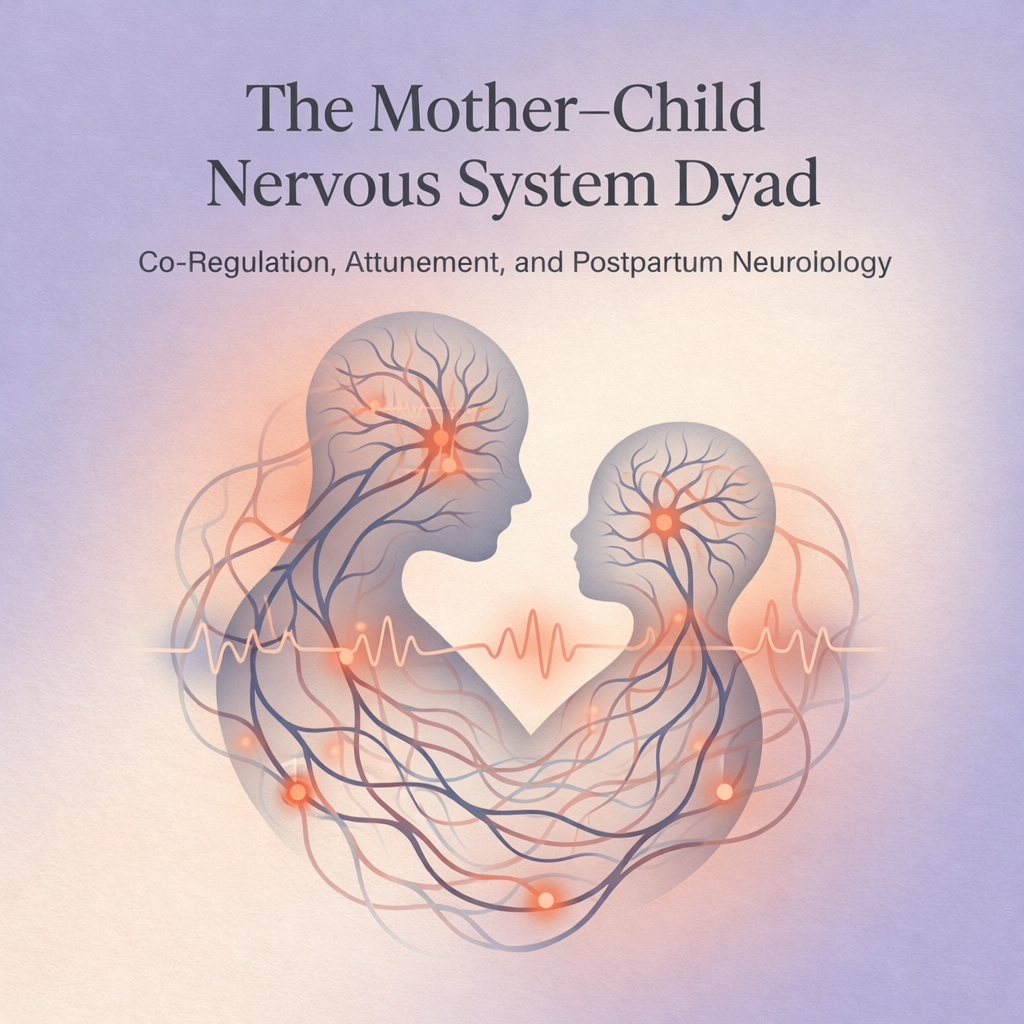
The Mother–Child Nervous System Dyad™ Audio Course offers an in-depth, developmentally grounded exploration of how a mother’s nervous system and her child’s nervous system function as an interconnected regulatory unit in early life.
Rather than treating maternal and infant regulation as separate processes, this course presents co-regulation as a biologically expected, neurologically embedded dynamic—one that profoundly shapes maternal stress physiology, emotional availability, identity stability, and long-term well-being. Drawing from attachment theory, developmental neuroscience, polyvagal research, and trauma-informed care, the course equips professionals with a precise framework for understanding why maternal nervous systems remain activated long after birth and why many mothers struggle to “self-regulate” in isolation.
Through a single, seamless audio narrative, participants are guided through the lived realities of dyadic regulation, including:
-
How maternal nervous systems become organized around infant dependency and threat detection
-
Why infant dysregulation directly impacts maternal capacity, mood, and sensory tolerance
-
The neurological basis of co-regulation and why separation-based expectations often fail mothers
-
How rupture and repair function within the dyad without indicating relational harm
-
The difference between infant meltdown, maternal soft collapse, and true nervous system shutdown
-
How systemic fragmentation and lack of shared care overload the maternal nervous system
The course challenges individualistic models of regulation and reframes maternal distress as a predictable outcome of sustained dyadic load without adequate containment or support. It clarifies why maternal burnout, irritability, emotional flattening, and withdrawal are often misdiagnosed when the dyadic context is ignored.
Designed for mental health clinicians, healthcare providers, birth workers, early childhood professionals, and anyone supporting mothers and infants, this training deepens clinical accuracy by restoring the relational and neurological context of early caregiving.
This course does not provide diagnostic criteria or treatment protocols. Instead, it offers a foundational lens for understanding how nervous systems develop in relationship—and how maternal well-being cannot be assessed or supported without acknowledging the dyad.
Mothers do not regulate alone.
Neither do babies.
Care improves when the dyad is understood.
How You’ll Receive This Audio
This is a digital audio course.
Access will be delivered via email within 24 hours of purchase.
Please ensure you use an active email address at checkout.